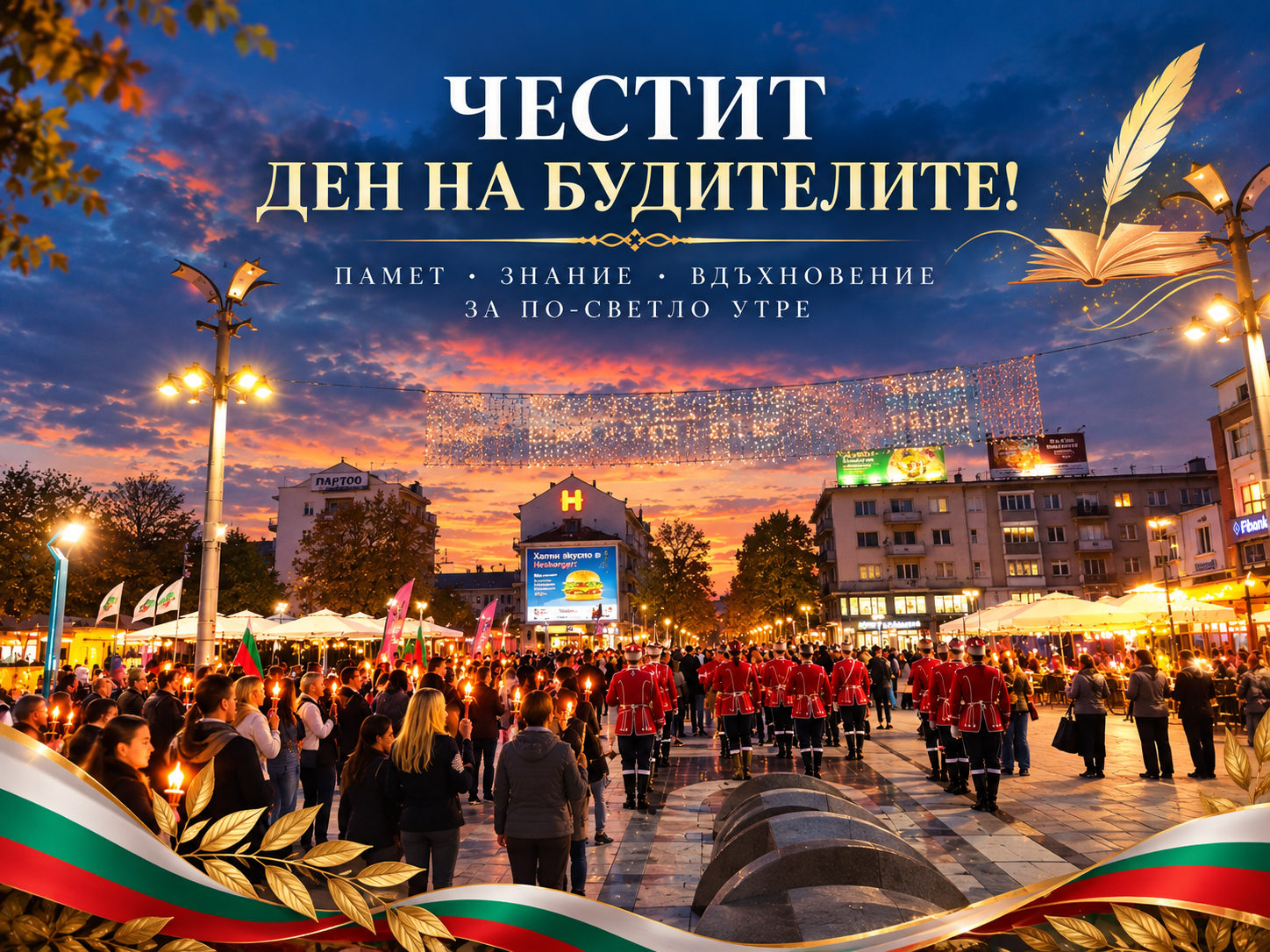
On 1 November, Bulgaria celebrates National Awakeners' Day, honouring the teachers, writers and educators who preserved the nation's language and memory.
It is an official non-school day for schools and universities, but an ordinary day for everyone else. In 2026 it falls on a Sunday. Below, we explain what the holiday means, how it began and how it is celebrated in Burgas.
The holiday at a glance
National Awakeners' Day — Den na narodnite buditeli — honours the educators, teachers and writers who preserved the Bulgarian language and historical memory during Ottoman rule.
- It is an official holiday and a non-school day for schools and universities. For everyone else, it is an ordinary working day: shops, transport and public institutions operate as usual.
- The main public events are evening torchlight processions by schoolchildren and concerts in community cultural centres, theatres and opera venues.
- Museums and galleries often offer free admission on the day.
- The municipality publishes its programme a few days before the holiday, and some events are moved to the nearest weekend.
Who were the National Awakeners?
The Bulgarian word buditel literally means someone who awakens others. It describes the people who, in the eighteenth and nineteenth centuries, rekindled Bulgarian national identity by writing in their native language, opening schools and community reading centres, and publishing books.
| National Awakener | Dates | Known for |
|---|---|---|
| Paisii Hilendarski | 1722–1773 | Slavonic-Bulgarian History (1762), a starting point of the Bulgarian National Revival |
| Sophronius of Vratsa | 1739–1813 | The first printed book in modern Bulgarian; a bishop and educator |
| Petar Beron | 1799–1871 | The Fish Primer (1824), the first secular schoolbook, used by generations of pupils |
| Vasil Aprilov | 1789–1847 | Founded the first secular school in Gabrovo (1835) |
| Hristo Botev | 1848–1876 | Poet and revolutionary who died during the April Uprising |
| Ivan Vazov | 1850–1921 | The patriarch of Bulgarian literature and author of Under the Yoke |
Today, the word has a broader meaning. It can also describe a contemporary teacher, scientist or doctor whose example inspires others to learn and think independently.
The holiday's history: abolition and revival
The holiday has not one birthday, but three.
- 1909, Plovdiv. The first day honouring educators and teachers was celebrated here as a city initiative.
- 1922, Sofia. Education Minister Stoyan Omarchevski proposed making 1 November a nationwide Day of the National Awakeners. A decree by Tsar Boris III established the national celebration, first observed across the country on 1 November 1923.
- 1945 and 1992. After 1945, the new authorities abolished the holiday. It was restored only in 1992, when it was also designated an official non-school day.
In 2026, 104 years have passed since the holiday was established, but it has been celebrated continuously for only 34 years. That interruption is part of the date's significance: a memory that people once tried to erase.
Legal and historical background: National Inspectorate of Education .
Why 1 November?
The connection with Saint John of Rila's day
The date was not chosen at random: it is linked to the feast of Saint John of Rila, the patron saint of the Bulgarian people. Under the old calendar he was honoured on 19 October; after the change to the Gregorian calendar, that date shifted to 1 November.
Thus, 19 October remained Saint John of Rila's day in the church calendar, while 1 November became a secular celebration of enlightenment: a pairing of the spiritual patron and those who continued his work in schools and printing houses.
Burgas: a torchlight procession and a concert at the Opera
The Torch of Knowledge
The city's most spectacular celebration is the torchlight procession organised for many years by the Trade High School. In 2026, its twelfth edition took place ahead of the holiday, on the evening of Friday, 30 October.
The route remains unchanged: the torch-bearing procession starts at Troykata Square, follows Aleksandrovska Street and reaches Atanas Sirekov Square in front of the municipal building, where graduating pupils recite poems about the National Awakeners.
This year the hosts were joined by pupils from the Konstantin Fotinov Vocational High School of Electrical Engineering and Electronics, Peyo Yavorov Primary School, Lyuben Karavelov Primary School, the Goethe German Language High School, Yordan Yovkov Secondary School, and the St Nicholas Vocational High School of Maritime Navigation and Fishing. For the first time, the Student Guard Unit of Asen Zlatarov University in Burgas also took part.
A vocal concert in the Opera foyer
On the eve of the holiday, 31 October at 19:00, State Opera Burgas presents a vocal concert in the theatre foyer. Eleven soloists perform, accompanied by three pianists.
The programme reflects the idea of cultural awakening: folk-inspired songs by Bulgarian composers Dobri Hristov, Pancho Vladigerov, Marin Goleminov, Georgi Zlatev-Cherkin and Todor Popov, alongside European classics including Rachmaninoff's Vocalise, Mimi's arias from La bohème and arias from Puccini's Manon Lescaut, and Brahms. The Opera explains its choice by describing today's singers and musicians as awakeners too, preserving language, roots and moral standards.
Available from the Opera box office, the Chasovnika ticket office outside Hotel Bulgaria, and online through Grabo and Eventim.
The weekend programme in Burgas
What else is open and happening in the city on 31 October and 1 November:
| When | Where | What |
|---|---|---|
| Sat, 19:00 | State Opera foyer | Vocal concert for National Awakeners' Day |
| Sat, 18:00 | Asen Zlatarov 1940 community cultural centre, 147 Aleksandrovska Street | A carnival evening among the bookshelves: visitors dress as literary characters |
| Sat, 18:30 | Youth Cultural Centre, 39 William Gladstone Street | IYC Talent Jam: an open stage for ages 15–29, featuring music, dance, theatre and stand-up |
| Sat, 11:00 | State Puppet Theatre, 2 Kliment Ohridski Street | Kokoshka s broshka, for children aged 4 and over |
| Sat, 10:00–18:30 | Georgi Baev Gallery, 6 Demokratsia Boulevard | Art workshops, with an evening ceramics session, Earth & Brush» |
| Sat and Sun, 19:00 | NHK Cultural Centre | CineLibri festival: Ostaynitsa on Saturday and Osta na zhivota on Sunday, both premieres followed by meetings with the teams |
| 31 Oct — 1 Nov | Flora Exhibition Centre, Sea Garden | Canary exhibition |
| until 4 November | Nesi Gallery, 3 Han Krum Street | Paintings and graphic art by Angel Geshev |
| until 15 November | Atelie Gallery, Magazia 1 | With Burgas in the Heart: 11 artists from the Sound and Colour collection |
| until 30 November | Historical Museum | In the Footsteps of the Disciples: the Cyril and Methodius Route in Bulgaria |
31 October is the final day of several exhibitions: Sgraffito Ceramics from the Bulgarian Lands, 13th–19th Centuries at the Archaeological Museum; the Anastenaria photography exhibition at the Ethnographic Museum; The Colour of Salt on the promenade in front of the Sea Casino; and Babylon by Zhanina Dubarova at the Artists' Society. They will no longer be open on Sunday.
The municipality announces school and local initiatives, including blood donation campaigns, children's art exhibitions and competition award ceremonies, a day or two before the holiday.
Celebrations in other towns and cities
The holiday is celebrated nationwide, usually with a similar programme: a prayer service and wreath-laying at a monument to a local educator, a procession, a community cultural centre concert, and awards for teachers and pupils.
Each city puts its programme together in its own way:
- In Plovdiv, where the holiday was first celebrated in 1909, events are traditionally linked to the city's schools and community cultural centres.
- In Sofia, the main ceremonies take place at the monument to Paisii Hilendarski on Moskovska Street, near Alexander Nevsky Cathedral.
- In smaller towns, celebrations are often moved to a nearby weekday or weekend so that schools can participate.
Event dates and times may change right up to the last day. Check the news section of your municipality's website for the latest local programme.
What newcomers should know
If you have recently moved to Bulgaria, there are three practical points to bear in mind.
- Schools and universities are closed; other places remain open. Shops, transport, banks and institutions follow their usual schedules. In 2026, 1 November is a Sunday, so the difference will hardly be noticeable.
- Museums and galleries often offer free admission. It is a good opportunity to visit places where you might normally hesitate over the ticket price, but check the arrangements on the individual museum's website.
- Evening processions close the city centre for an hour to an hour and a half. In Burgas this affects Aleksandrovska Street; elsewhere, it is usually the main pedestrian street. Allow extra time if you are planning dinner in the centre.
Frequently asked questions
Is 1 November a day off in Bulgaria?
It is an official holiday, but only schools and universities have a non-school day. Everyone else follows their normal schedule. In 2026 the date falls on a Sunday.
What does the word buditel mean?
Literally, it means someone who awakens others. It refers to the educators of the eighteenth and nineteenth centuries who preserved the Bulgarian language, opened schools and published books.
Why is the holiday celebrated on 1 November?
The date is linked to Saint John of Rila, the patron saint of the Bulgarian people. Under the old calendar he was honoured on 19 October; after the change to the Gregorian calendar, the date shifted to 1 November.
Was the holiday really abolished at one point?
Yes. Established in 1922, it was abolished after 1945 and returned to the calendar only in 1992, when it was also designated a non-school day.
Where does the torchlight procession take place in Burgas?
The route has been unchanged for years: from Troykata Square along Aleksandrovska Street to Atanas Sirekov Square in front of the municipal building. It is organised by the Trade High School.
Does the procession always take place on 1 November?
Not necessarily. The date is chosen to suit schools: in 2026 the procession took place on the evening of Friday, 30 October. Check the programme against the municipality's news updates.
What is there to see with children on the day?
In Burgas, options include the puppet show, art workshops at the Georgi Baev Gallery and the canary exhibition at Flora, as well as the torchlight processions themselves, which children tend to remember for a long time.
Life in Bulgaria: help and contact details
Holidays such as National Awakeners' Day are part of the everyday life that each family gradually becomes part of after moving to Bulgaria. Questions about residence status, documents and deadlines remain important alongside them.
Window to Bulgaria helps you understand the legal requirements and prepare documents for immigration procedures.
Let's start with your question
Tell us about your circumstances and the residence status you are applying for in Bulgaria. We will help you identify the next steps.
Contact us in whichever way suits you.
All contact options and social media →
The programme has been checked against information from Burgas Municipality, the State Opera and local publications as of 31 October 2026. Organisers may change dates and times right up to the last day, so check the listings before leaving home.